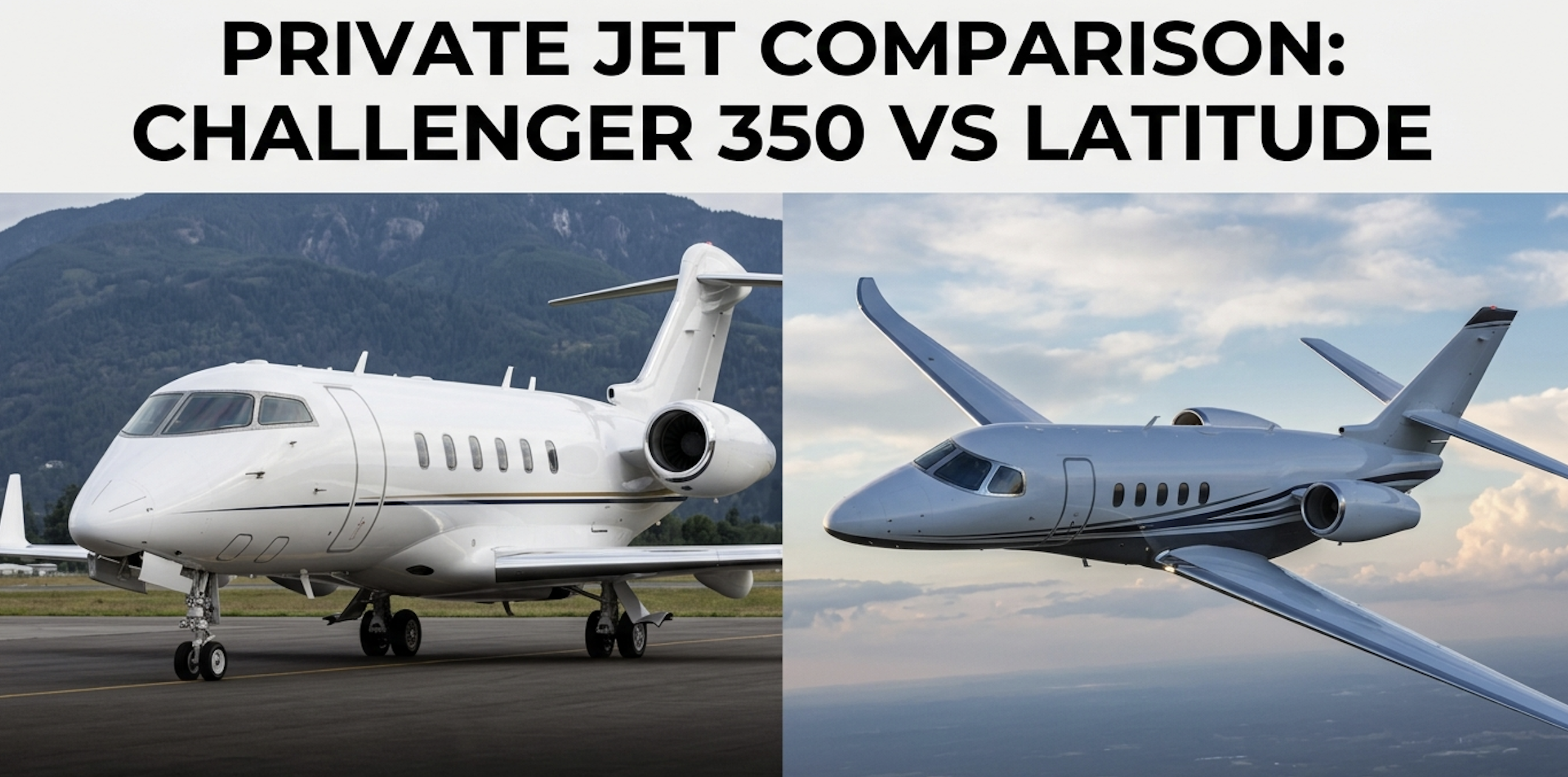
Bombardier Challenger 350 vs. Cessna Citation Latitude: Which Midsize Jet Is Right for You?
Two of the most popular midsize jets on the market, head to head. Range, cabin, costs, and what each does better.
By PrivateJetNation · 5 min read
Two of the most popular midsize jets on the market, head to head. Range, cabin, costs, and what each does better.
By PrivateJetNation · 5 min read
The two jets that dominate the midsize category, compared honestly.
If you are buying a midsize private jet in 2026, the Bombardier Challenger 350 and the Cessna Citation Latitude are likely on your short list. They are the two most widely sold and most actively traded aircraft in the category, with large operator bases, strong maintenance infrastructure, and pre-owned markets that offer genuine selection.
They are also genuinely different aircraft that suit different buyers. Understanding where each excels, and where each falls short, is more useful than reading either manufacturer's marketing materials. This is the comparison without the sales pitch.
| Metric | Challenger 350 | Citation Latitude |
|---|---|---|
| Passengers | 8 to 10 typical | 7 to 9 typical |
| Range (NBAA IFR) | 3,200 nm | 2,700 nm |
| Cruise speed | High 0.83 Mach | High 0.80 Mach |
| Cabin length | 25 ft 2 in | 21 ft 9 in |
| Cabin width | 7 ft 11 in | 5 ft 9 in |
| Cabin height | 6 ft 1 in | 5 ft 11 in |
| Baggage | 106 cu ft | 89 cu ft |
| New list price (approx) | $26 to $28M | $18 to $20M |
| Pre-owned (2020 model) | $18 to $23M | $11 to $15M |
| Annual fixed costs (est) | $1.1 to $1.6M | $850K to $1.2M |
| Engines | Honeywell HTF7000 | Pratt and Whitney Canada PW306D |
| Engine program | MSP Gold | ESP Gold |
The Challenger 350 has one of the most distinctive cabin advantages in the midsize category: a wide body cross-section with a 7 foot 11 inch cabin width that creates a genuinely spacious interior. Passengers sit across from each other rather than slightly angled, and the overall experience for a full cabin load of eight to ten passengers is meaningfully better than any narrower aircraft in the same price range.
With NBAA IFR range of 3,200 nautical miles, the Challenger 350 covers the continental U.S. nonstop from virtually any origin to any destination. The Citation Latitude at 2,700 nautical miles covers most domestic routes but requires a stop on the longest transcontinental missions.
The Citation Latitude carries a meaningfully lower acquisition cost than the Challenger 350 at comparable model years, typically $6 million to $8 million less on pre-owned transactions. Annual operating costs also favor the Latitude, with fixed costs running approximately $200,000 to $400,000 less per year depending on crew structure and management approach.
The Citation Latitude's lighter weight and Pratt and Whitney Canada engines give it slightly better performance at airports with runway or elevation constraints.
Which Aircraft Is Right for Which Buyer?
The Challenger 350 is typically the better choice for buyers who: frequently fly eight or more passengers, value the in-flight experience and cabin comfort, fly international or extended range missions regularly, or are based at a major hub with robust Bombardier service access.
The Citation Latitude is typically the better choice for buyers who: primarily fly domestic routes under 2,500 nautical miles, operate with smaller passenger loads of four to six people, are cost-conscious about both acquisition and annual operating budget, or fly frequently into airports with runway or performance constraints.
Both aircraft are genuinely excellent midsize jets with strong safety records, active pre-owned markets, and robust support networks. The choice between them is primarily a function of your specific mission profile: cabin size requirements, route distances, passenger loads, and budget. Neither is a compromise at what it does well.