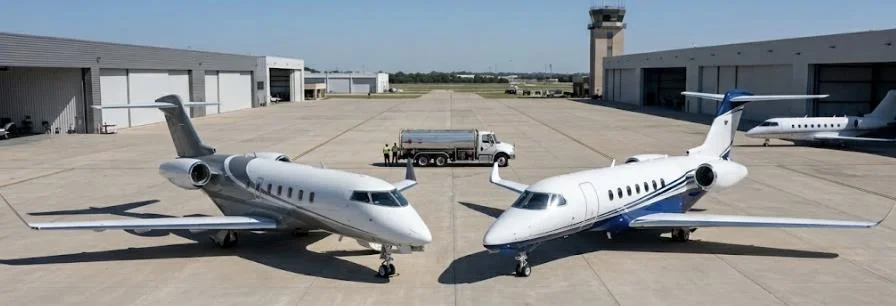
Challenger 350 vs Citation Longitude: Super-Midsize Showdown
Our Challenger 350 vs Citation Longitude showdown compares the top two super-midsize business jets on cabin space, range, operating costs, and value.
By PrivateJetNation · 5 min read
Our Challenger 350 vs Citation Longitude showdown compares the top two super-midsize business jets on cabin space, range, operating costs, and value.
By PrivateJetNation · 5 min read
Evaluating a **Challenger 350 vs Citation Longitude** matchup is the classic super-midsize dilemma for business jet buyers. There is a reason the super-midsize category has become the most competitive segment in business aviation. These aircraft sit at an almost perfect intersection of range, comfort, operating cost, and versatility. They can handle most domestic missions with ease, manage transatlantic hops on the right routes, offer stand-up cabins, and cost significantly less to operate annually than large-cabin jets. Two aircraft dominate conversations in this space: the Bombardier Challenger 350 and the Cessna Citation Longitude.
The typical private jet buyer who lands on a super-midsize aircraft has usually gone through one of two journeys. Either they are stepping up from a midsize jet and want more cabin room and range without jumping all the way to a large-cabin price tag, or they started their search at the large-cabin level and found that a super-midsize could actually cover 90 percent of their trips for 60 percent of the annual operating cost.
Both of those are legitimate paths, and both reflect why this category keeps growing. Super- midsize jets seat 8 to 10 passengers comfortably, offer range in the 3,400 to 4,000 nautical mile band, cruise at speeds above 500 miles per hour on many models, and can access a wider range of airports than their larger siblings because they require shorter runways.
The Challenger 350 is one of the most popular business jets in the world, and it has earned that status through consistent performance rather than marketing. The aircraft's cabin is wide by super-midsize standards at 7 feet 2 inches and features a flat floor, which means the aisle is level from front to back with no steps. That sounds like a small thing until you have stepped on and off enough jets with awkward floor transitions to appreciate it.
Range on the Challenger 350 is approximately 3,200 nautical miles, covering routes like Los Angeles to New York, Miami to London with favorable winds, and most intra-European routes. Cruise speed is around 500 miles per hour, and the aircraft is certified to fly at up to 45,000 feet, which allows it to cruise above most weather.
Bombardier's service network is extensive, with authorized service centers located throughout North America, Europe, Asia, and the Middle East. For operators who travel internationally, that kind of support infrastructure matters. The Challenger 350's resale value has also been strong historically, which is relevant for buyers thinking about their exit strategy.
The Citation Longitude entered service in 2020 and quickly established itself as a credible alternative to the Challenger 350. Its range of approximately 3,500 nautical miles edges out the Challenger slightly, and Textron has designed the cabin with comfort as a visible priority. The interior is quiet, well-appointed, and consistently praised by passengers for the ride experience.
One of the Longitude's notable advantages is its inclusion in Textron's Citation Service Plan, which is an all-inclusive maintenance program that covers scheduled maintenance for a fixed per-flight-hour rate. For owners who want predictable cost structures, that kind of program has real appeal. Bombardier offers similar programs on the Challenger 350 through Smart Services, but the Longitude's integration with the Cessna dealer and service network in North America is particularly strong for domestic operators. In terms of direct operating costs, the **Challenger 350 vs Citation Longitude** debate remains exceptionally close.
The Longitude is also slightly quieter than the Challenger 350 at cruise, which matters for passengers on longer flights and for airports with noise restrictions.
If your flying is primarily domestic and you value the widest possible service network for an aircraft that logs high utilization, the Challenger 350 is a hard choice to argue against. It is the most proven and widely supported aircraft in the category.
If you want slightly more range, a newer platform with strong warranty and maintenance program support, and a cabin that passengers consistently rave about, the Longitude deserves
a serious look.
Current new purchase prices for both aircraft fall in the $26 to $34 million range depending on configuration. Pre-owned Challenger 350s from 2018 to 2021 are frequently available in the $15 to $22 million range and represent strong value for buyers comfortable with a bit more airframe time.
Either way, the super-midsize segment delivers the kind of balanced performance that makes it the right answer for a very large number of buyers. The growth in this category is not a coincidence.
======================================================================== ======== Determining the winner of the **Challenger 350 vs Citation Longitude** comparison depends heavily on your typical runway and trip profile.
Private Jet Nation connects aircraft owners with resources, advisory services, and listings across the private aviation market. Explore privatejetnation.com.