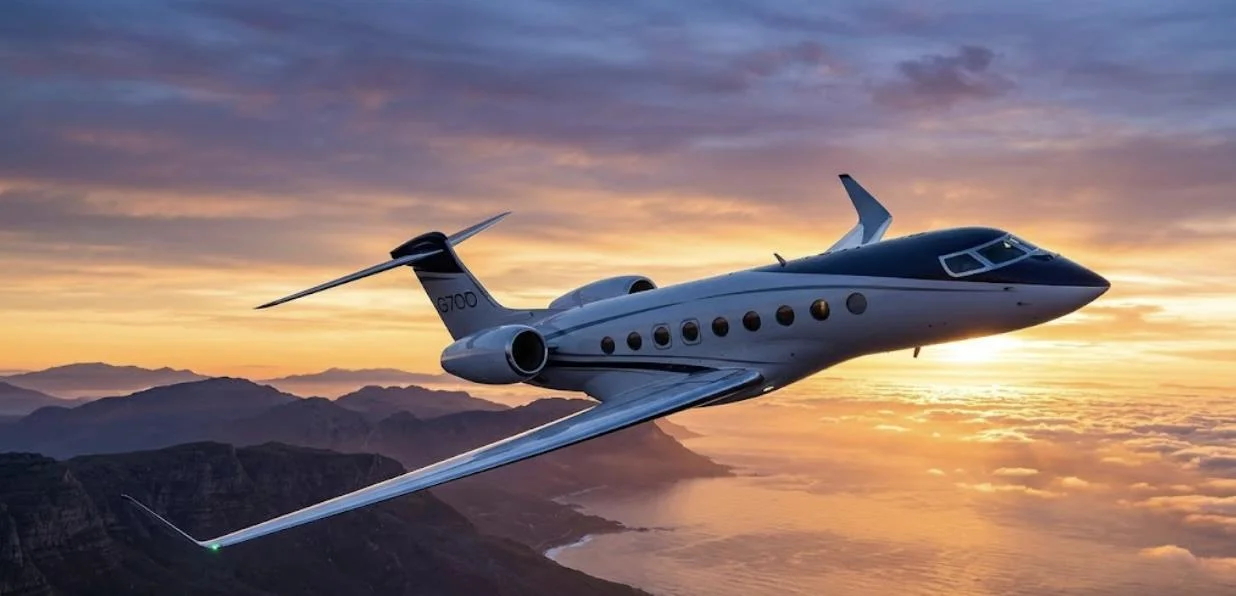
Reading a detailed **Gulfstream G700 review** is essential for understanding this class-leading business jet. If you've been paying attention to the private jet world lately, you've probably heard the Gulfstream G700 come up more than a few times. It sits at the very top of Gulfstream's lineup, it costs somewhere north of $78 million, and it has quickly become one of the most talked-about aircraft in business aviation. But what actually makes it worth that price tag, and is it really the best option in the large-cabin category? Let's break it down.
The Core of our Gulfstream G700 Review: Performance and Design
The G700 is a long-range, large-cabin jet that can carry up to 19 passengers depending on how the interior is configured. Its range sits at approximately 7,500 nautical miles, which means you can fly nonstop from New York to Tokyo, London to Los Angeles, or Dubai to New York without stopping to refuel. For executives, families, and high-net-worth travelers who do a lot of transatlantic or transpacific flying, that kind of range is genuinely useful rather than just impressive on paper.
The cabin itself is one of the biggest selling points. Gulfstream designed the G700 with the industry's first full-size forward galley on a purpose-built business jet, which means the crew has a real, functional workspace rather than a cramped closet. The cabin features up to five living areas depending on configuration, and owners frequently customize these spaces into combinations of a master suite, conference room, dining area, and entertainment lounge. Ceiling height clocks in at 6 feet 3 inches, and the cabin width is 8 feet 2 inches, which makes it one of the most spacious purpose-built business jets flying today.
The Cabin Altitude Advantage
One thing that tends to surprise first-time G700 buyers is the cabin altitude technology. Gulfstream engineered the G700 to maintain a cabin altitude of 4,850 feet when cruising at 51,000 feet. In practical terms, that means passengers arrive feeling significantly less fatigued than they would on a commercial flight, where cabin pressure typically simulates an altitude of 6,000 to 8,000 feet. On long hauls, that difference is noticeable. Travelers report sleeping better, feeling more alert on arrival, and experiencing less of the headache and dehydration that typically come with long international flights.
How It Stacks Up Against the Competition
The G700's two most direct competitors are the Bombardier Global 7500 and the upcoming Dassault Falcon 10X.
The Global 7500 has been on the market since 2018 and is a proven aircraft with an exceptional reputation. Its cabin offers four distinct living spaces, a full-size kitchen, and a dedicated crew rest area. Its range of approximately 7,700 nautical miles actually edges out the G700 slightly, and its smoothness in turbulence is frequently praised by pilots and passengers alike. Many buyers who fly Bombardier argue the ride quality is simply unmatched.
The Dassault Falcon 10X is still in development and just made its maiden flight in 2026, with customer deliveries expected in 2027. When it does arrive, it will bring the widest cabin of any purpose-built business jet at 9 feet 1 inch across. Dassault is positioning it directly against both the G700 and the Global 7500, and early specs suggest it will be a serious competitor. As any modern **Gulfstream G700 review** will highlight, the cabin's 100% fresh air and low cabin altitude set new industry standards.
Running Costs: What to Expect
The purchase price is only the beginning when it comes to owning a G700. To understand the full financial commitment, check out our guide on the cost of private jet ownership. Annual operating costs typically run between $4 million and $6 million depending on how many hours you fly, where you fly, and how you staff the aircraft. That figure includes crew salaries and training, fuel, scheduled maintenance, hangar fees, insurance, and management fees if you use a third- party management company. Fuel alone can represent 30 to 40 percent of annual operating costs, which is worth keeping in mind as fuel prices continue to fluctuate.
That said, many G700 owners place the aircraft on a charter certificate when they are not using it personally, which can offset a meaningful portion of operating costs. The G700's premium positioning in the charter market means it commands some of the highest charter rates available, typically in the range of $25,000 to $35,000 per flight hour depending on the route and market.
Who Is the G700 For?
The G700 makes the most sense for buyers who fly more than 400 hours per year, regularly operate transatlantic or transpacific routes, want the absolute latest in cabin technology and comfort, and have the budget not just to purchase the aircraft but to operate it properly. For occasional private flyers or those whose routes stay within the continental United States, a super-midsize or large-cabin jet in a lower price tier will likely serve just as well for significantly less.
But if range, cabin experience, and staying power in the charter market are priorities, the G700 is genuinely hard to argue with.
======================================================================== ======== Ultimately, this **Gulfstream G700 review** confirms that the aircraft represents the absolute pinnacle of ultra-long-range luxury flight.
Private Jet Nation connects aircraft owners with resources, advisory services, and listings across the private aviation market. Explore privatejetnation.com.